The Open Runtime for Physical AI
Give AI a world to run, and learn.
Let the machines we already have, and the next generation embodied intelligence now arriving, understand goals and coordinate at a grander scale. Let every new operation begin where the last one graduated, and go further. Adastra is the operating mind that binds everything together.
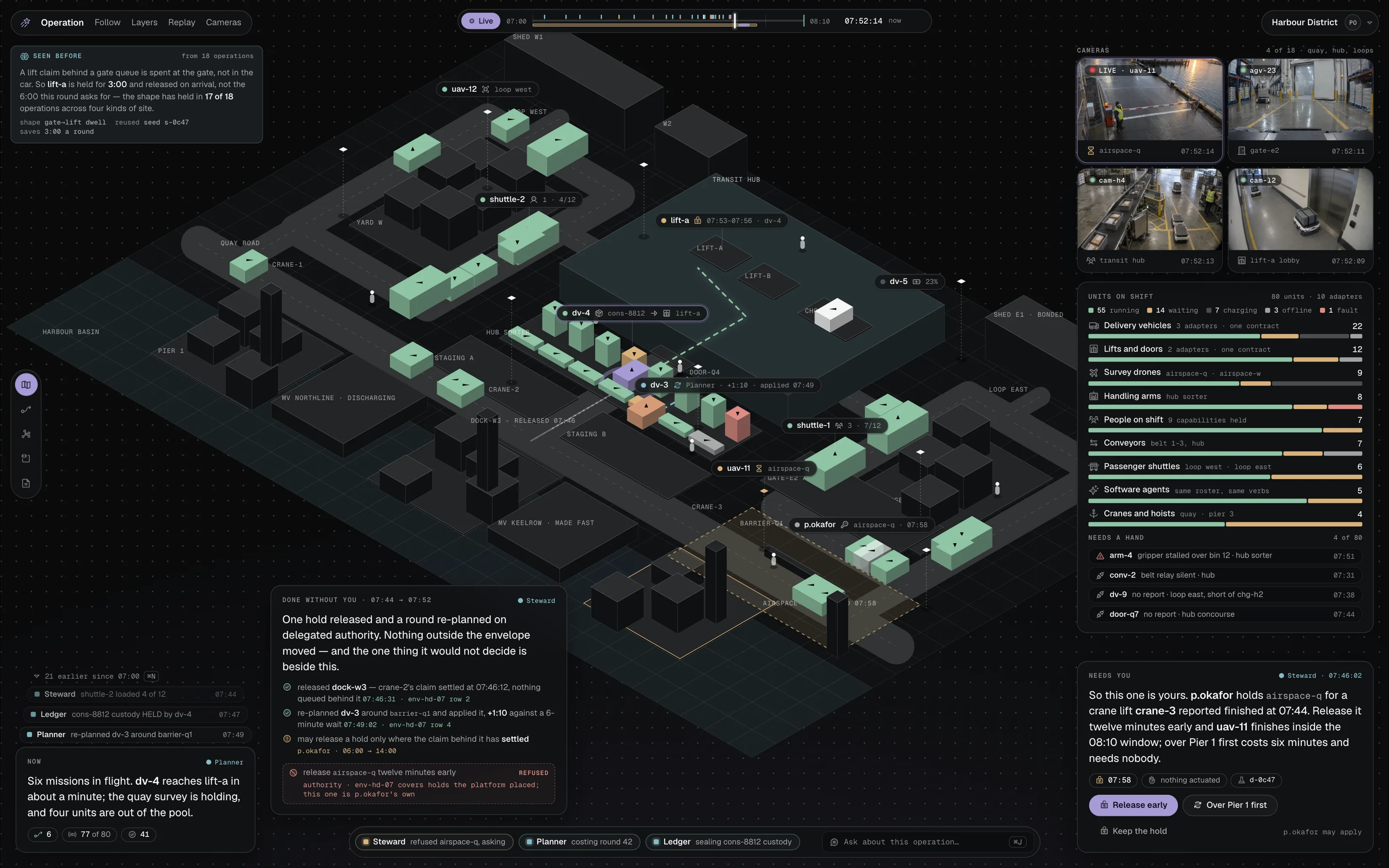
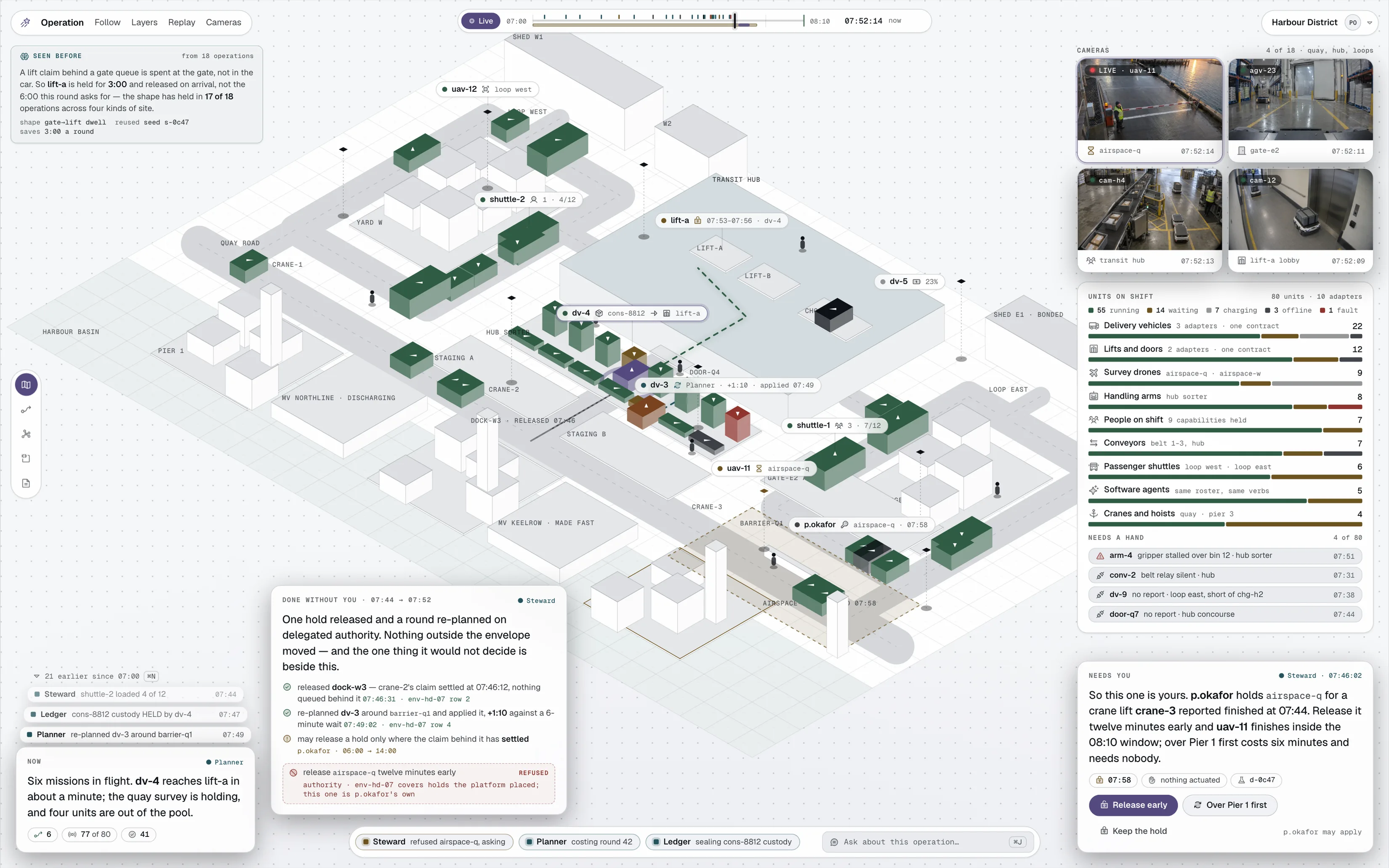
Every operation should leave the next one wiser.
The Open Runtime for Physical AI gives the operating mind something real to learn from: a world it can perceive, work it can carry, and evidence of what happened. It learns from a desensitised, abstracted model of the work: the shapes and first principles of how operations flow, never a site’s raw record. Your operational record stays in your organisation.
Not middleware. Not a fleet manager. Neither of those learns. The mind reaches an operation through three faces: the Agent is its avatar, the Platform is its operating surface and its feed, and the Companion is its eyes, ears and hands beside the machine.
Perceive
The operation as it is. Every unit, claim, custody report and reading, in one typed picture that says where each fact came from and how stale it is.
Act
Work carried through, with evidence. An avatar that holds the pen in your operation, a Companion that holds the machine, one typed verb against real hardware.
Learn
The next operation starts with what the last one taught. The shape of the work, the model it had to build, the decisions that held.
The bodies are getting smart. The world they work in is not.
We do not build the intelligence inside the body. We build the mind that runs the operation around it, and the world it can join.
A new kind of machine is arriving.
The last generation waited for commands. This one is given a goal, works out how, picks up capabilities it did not ship with, and decides things on its own.
The world it walks into was built for the last one.
Fleet software, site infrastructure and workflow tools all assume a known machine, a fixed API, a task assigned centrally and a person watching. None of that describes what is arriving.
Intelligence in the body does not solve the operation around it.
A humanoid that can reason still has no identity in your operation, no claim on a lift, no record of what happened before it arrived, and no way to work with the conveyor that cannot reason at all.
A place in the operation.
An embodied agent here is a participant, not a device on the end of a call. It takes goals, reports what it found, asks for what it needs, argues with a decision, and acts inside authority it was given. Six things it has to be given before any of that is possible.
An identity and a role
A unit in the operation, not a device on a network.
A world it shares
Spaces, other units, infrastructure, and what is true right now.
Work that outlives it
Missions with owners and a journal that survives a restart.
Claims it can hold
A lift, a bay, a dock, granted over an interval and released.
Authority, delegated
What it may decide alone, and what waits for the whole picture.
Memory and evidence
What happened before it arrived, and what it did once there.
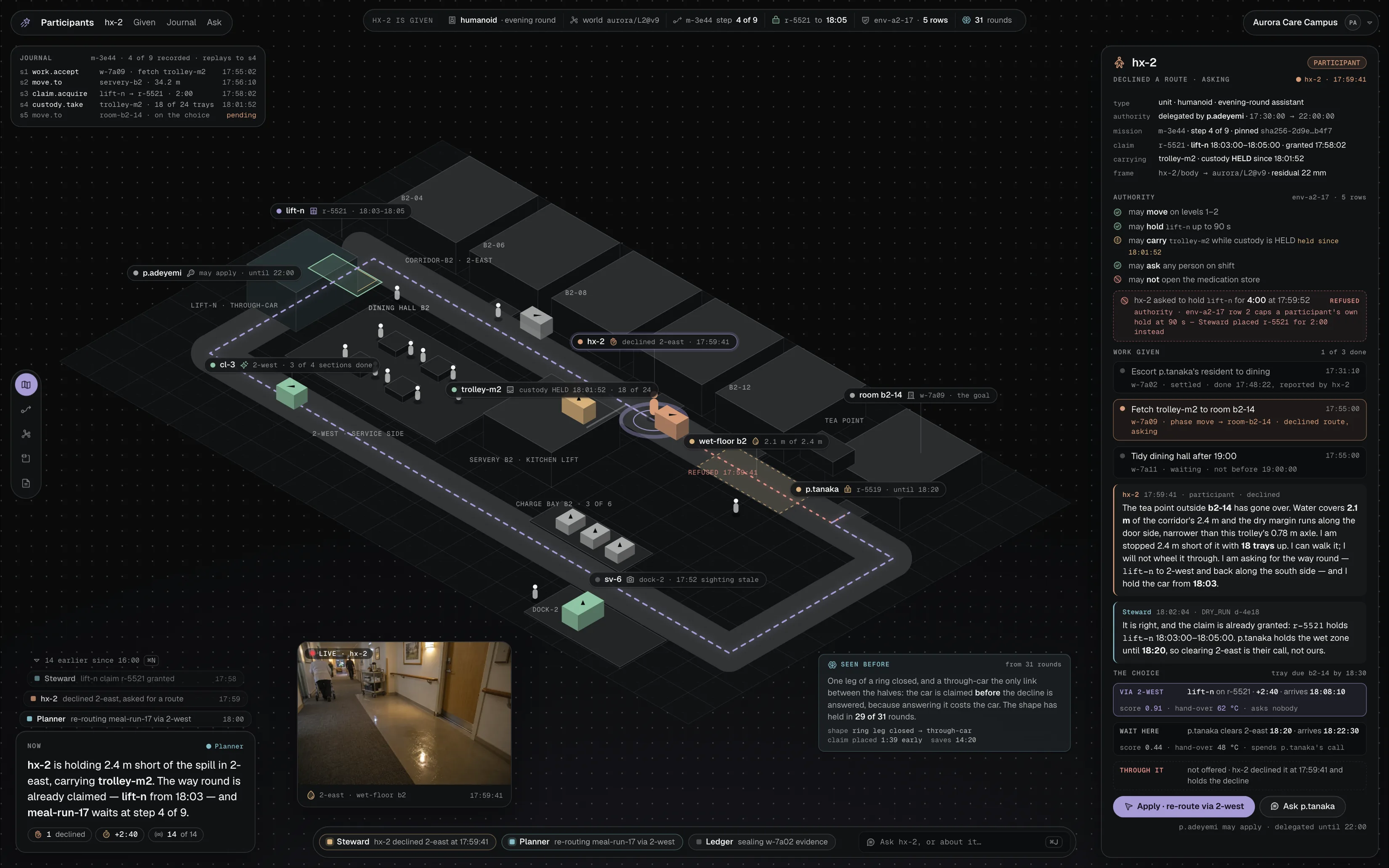
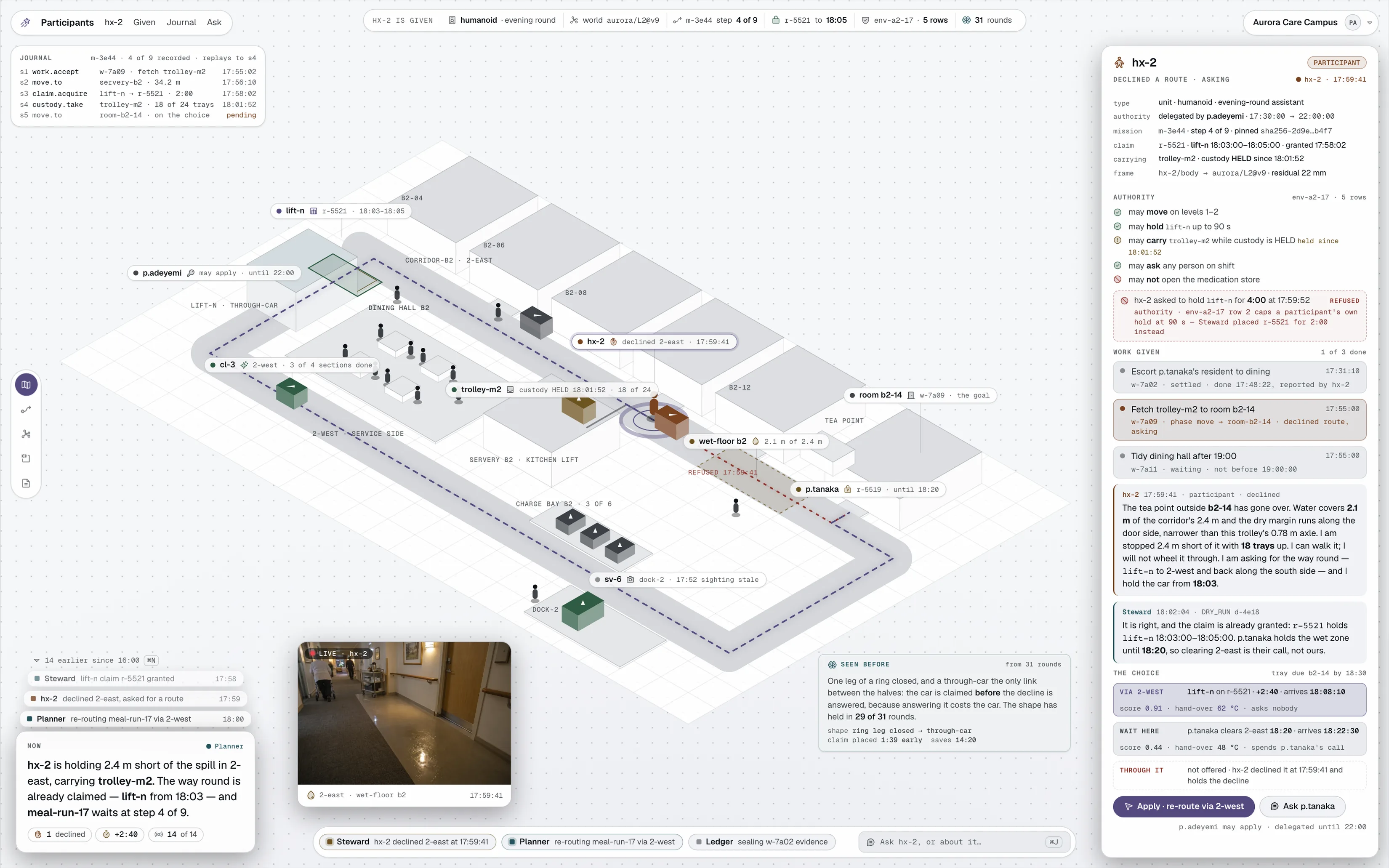
The same world holds the machines that cannot reason at all. A conveyor with a Companion bolted to it is a unit with a place in the operation, and an agent works with it the way it works with anything else.
What runs, and where.
A runtime runs programs. Ours runs the operation, and agents write it. One change travels one path to a machine and back, and every step is a platform object with an identity. Nothing here reaches inside a body to drive it: the intelligence and the control loop in a humanoid or a vehicle stay its own, and this is the world it acts in.
Agent commits
A branch in the operation's own repository.
Scenario proves
Compiles, passes its specs, and is pinned by the digest of its bytes.
Operation runs durably
A journal, not a process. It survives a restart mid-mission.
Companion carries it
The same digest, beside the machine, with or without an uplink.
Machine acts
One typed verb against real hardware. Move means arrive.
Evidence returns
What was decided, what was rejected, and why.
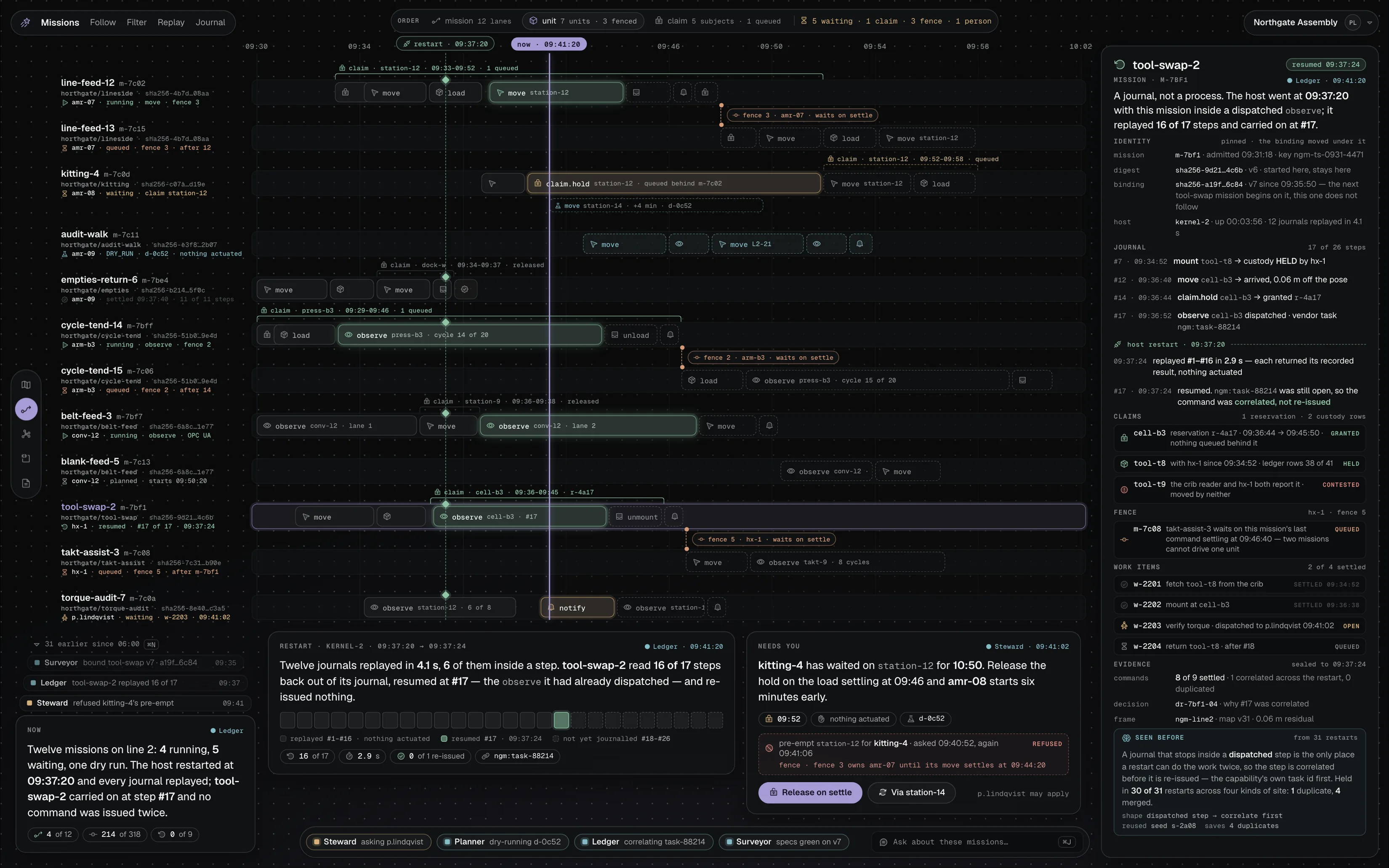
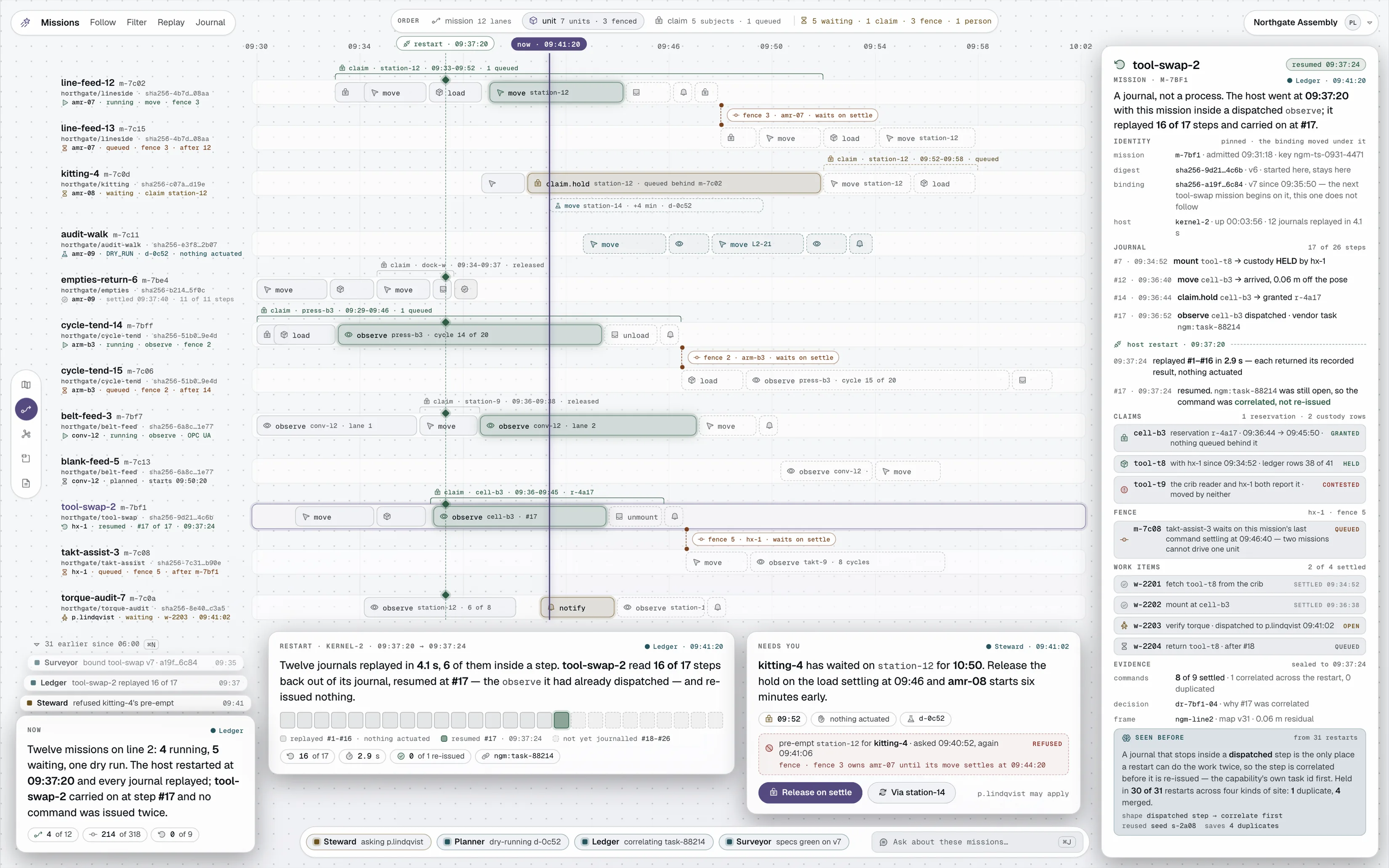
Scenarios are the programs, missions the processes, the world model the memory, verbs the system calls.
Read the runtimeThis has been built many times. It has never been solved.
A generation of fleet software now runs real sites: mixed vendors, lifts and doors, people and hardware moving among each other. It works, and every one of those systems was built for a person to click. Intelligence arrived afterwards, as a panel bolted to the side, because there was nothing underneath for it to write to.
And the hard parts stayed hard. A vendor reports one job twice, under two ids, a minute apart, and two halves of the same system believe different things. Exactly-once at a vendor boundary is not something anyone gets by assumption. Neither is knowing where a thing physically is. Systems that assume otherwise are the reason coordination across an operation is still a person with a radio.
And every one of those systems threw away what it learned. A site went live, a thousand decisions were made, and none of it reached the next site, because there was nothing for it to reach.
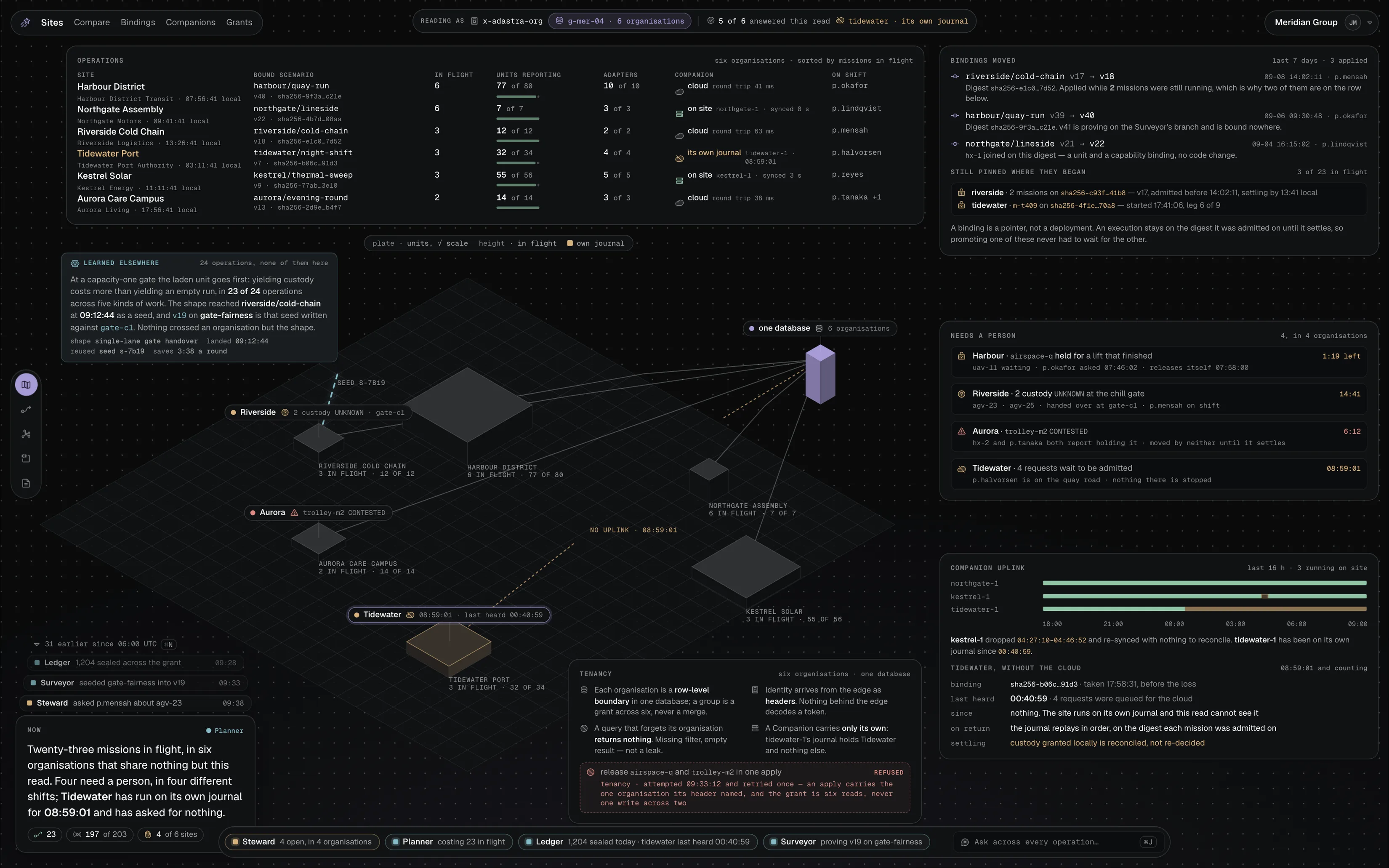
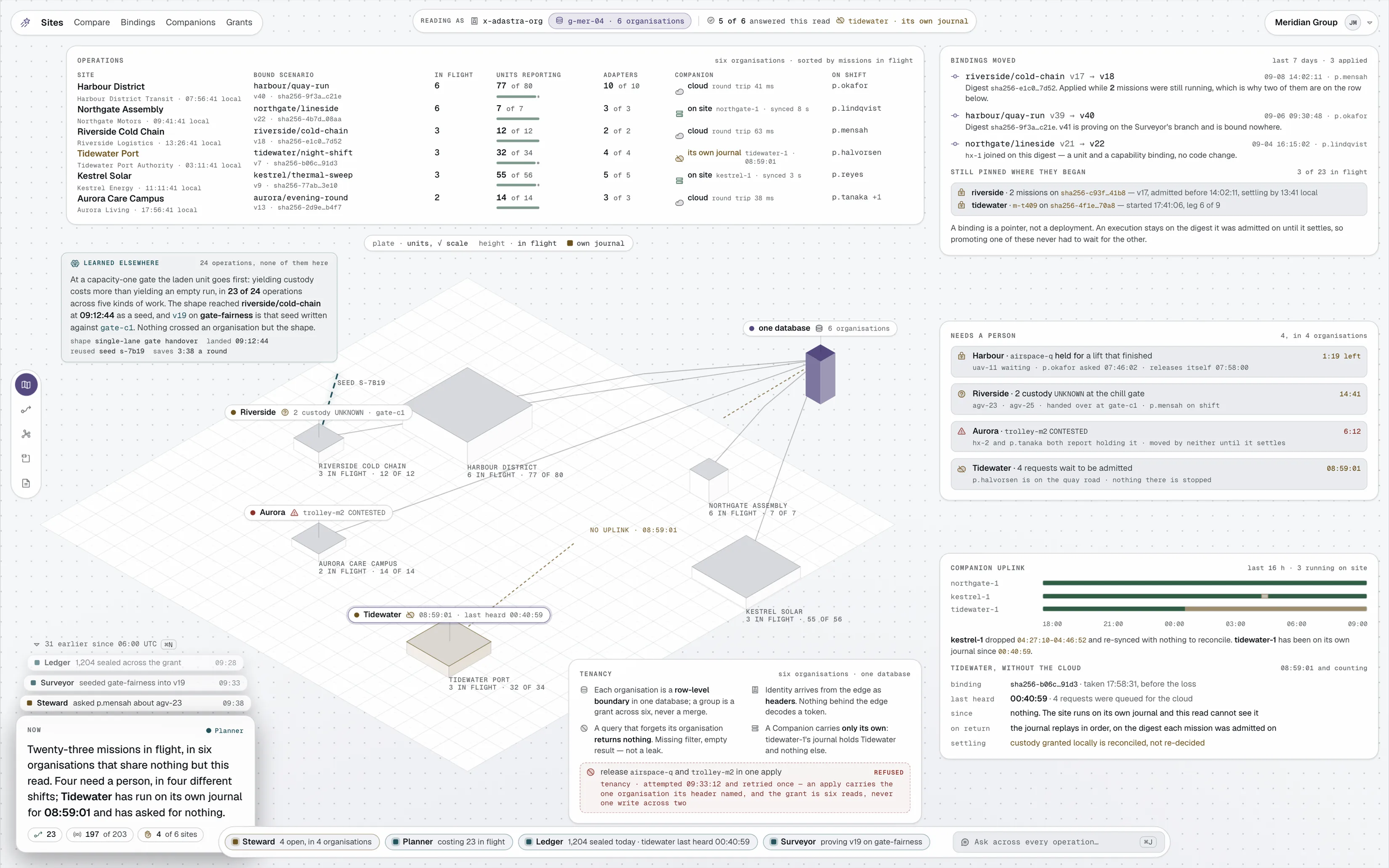
We know those failures in detail, from the inside, and this platform is built around them rather than over them. Reconciliation at every vendor boundary. A custody model that admits it does not know. An operation an agent can write, because that was designed in from the first day rather than added when the models arrived. And nothing it learns is thrown away.
One workflow is the wedge. The mind is the company.
What we leave behind at a site is a runtime that already knows it. Your operational record stays in your organisation. What the mind carries on is what the work taught it about operating: the ontology, the scenarios, the seams, and the experience of having done it, sharper every time.
One workflow
A bounded, brownfield job across systems that were never designed to cooperate. The first thing the mind sees of your world.
Reusable scenarios and seams
What that workflow needed becomes a scenario, a typed capability and a piece of ontology the mind now holds, reusable anywhere.
Faster adjacent workflows
The next one at the same site is a scenario, not a project. The model and the units are already there, and so is what the first one taught.
More systems, more sites
Vendor N+1 is data. A site is a Companion and a binding. A humanoid joins the way a forklift did, and the mind arrives already knowing the shape of the work.
A mind that compounds
Every operation it runs makes it better at running operations. Your record stays in your organisation; what it learned about operating is what carries on.
Where it goes
The core names no domain at all.
A concept reaches the core only if it carries unchanged into work we have never seen. That is a hard bar and it is the whole design, because what it buys is an operation nobody had to anticipate: a unit is an AMR, a drone, an arm, a conveyor, a person or a software agent, and the platform never learns which.
So the work below is illustration, not scope. The one an agent writes next week is more likely to be something we would not have thought of.
What the core knowsHumanoids and embodied AI
Bodies walking into work shaped for people.
Cities that run themselves
Vehicles, drones and infrastructure across a district.
Warehouse and industrial
The most automation installed, the least coordinated.
The AI workforce
Digital workers beside physical ones, one record.
And the one nobody has named
A scenario is code an agent writes, so the next operation this runs is one we never designed it for.
We enter through one workflow.
A brownfield site. Machines from more than one vendor, shared lifts and doors, a fleet manager that is not ours, and one job that crosses all of it. Live in thirty days, on a runtime the site keeps. Then the next workflow is a scenario, not a project.
That is the bridge, not the destination. An operation already running four vendors and a shared lift is the operation an agent has to arrive into, and the runtime is the same one either way.
What fits, and what does notA small number of design partners.
One site, one workflow, more than one vendor, shared infrastructure. The offer is bounded on purpose, and it comes with a model you keep.
And the people who back category creation.
The industry has a copilot. It does not have the thing a copilot would need underneath it, and it has never had a mind above it that learns from every site at once. That is the company.