Companion
One mind that oversees the whole operation. Eyes, ears and hands that never leave the work.
Global orchestration that can be optimised, and local intelligence that cannot be cut off. The Companion is the second: the mind’s eyes, ears and hands, standing where the machine is and running when the uplink does not.
The name is the design.
A Companion lives beside something. It pairs with one machine, or one cell, or one site, and it stays. It carries that thing’s slice of the world, acts for it when nobody upstream is answering, and speaks for it to whatever is standing next to it.
It is the same software at three sizes, and the site appliance is simply the largest of them.
On the unit
A small box that rides with the machine. It holds the unit's own slice of the world model, runs its verbs locally, and speaks for it to its neighbours.
In the cell
One Companion for a line, a bay or an intersection. It arbitrates among the units that share that space without a round trip to anywhere.
At the site
The largest radius: a rack that authors, promotes and rolls back a whole site with its uplink down, and reconciles when it returns.
What it gives a machine.
The senses and the ledger
What the machine sees, what it did, and what actually happened around it, recorded beside it in real time. It is written where the truth is, and it stays there: the operation keeps its own record.
Old iron, new soul
Bolt a Companion onto a twenty-year-old conveyor and it becomes a unit with intent, a place in the world model, and a voice in the swarm. Nothing about the conveyor changes.
Swarm without the cloud
Units negotiate a door among themselves when the uplink is gone, inside the authority the platform delegated to that cell. What was decided is recorded and reconciled when the uplink returns, and nobody stood still waiting.
The reflex, not the thought
A stop, a yield, a hold: the decisions that cannot wait for a data centre are made beside the machine, from policy an agent wrote and the platform pinned.
The site decides what leaves it
Execution is local and the uplink carries planning and evidence. What crosses it is declared per stream, in data you can read, and a site can run with nothing crossing at all.
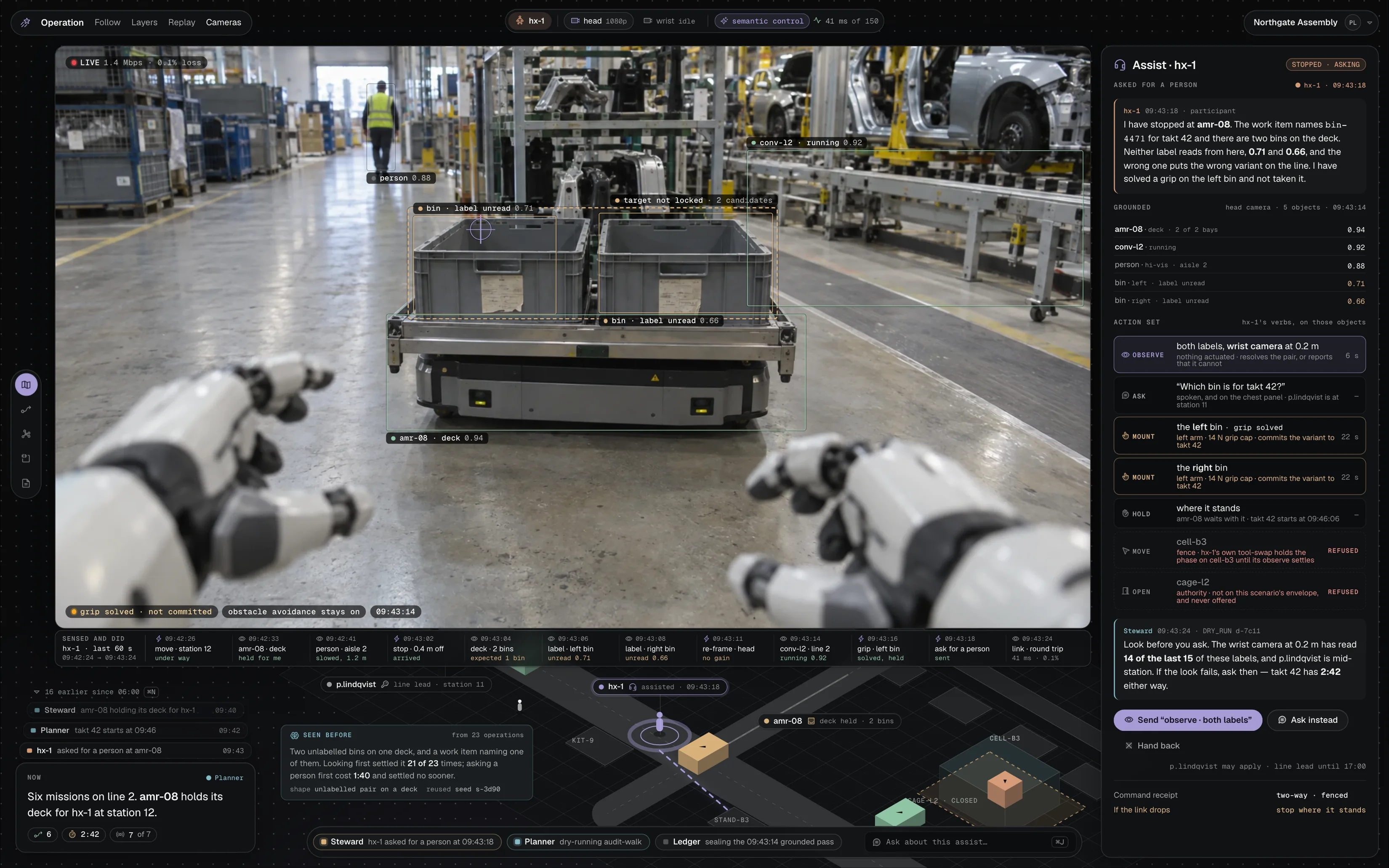
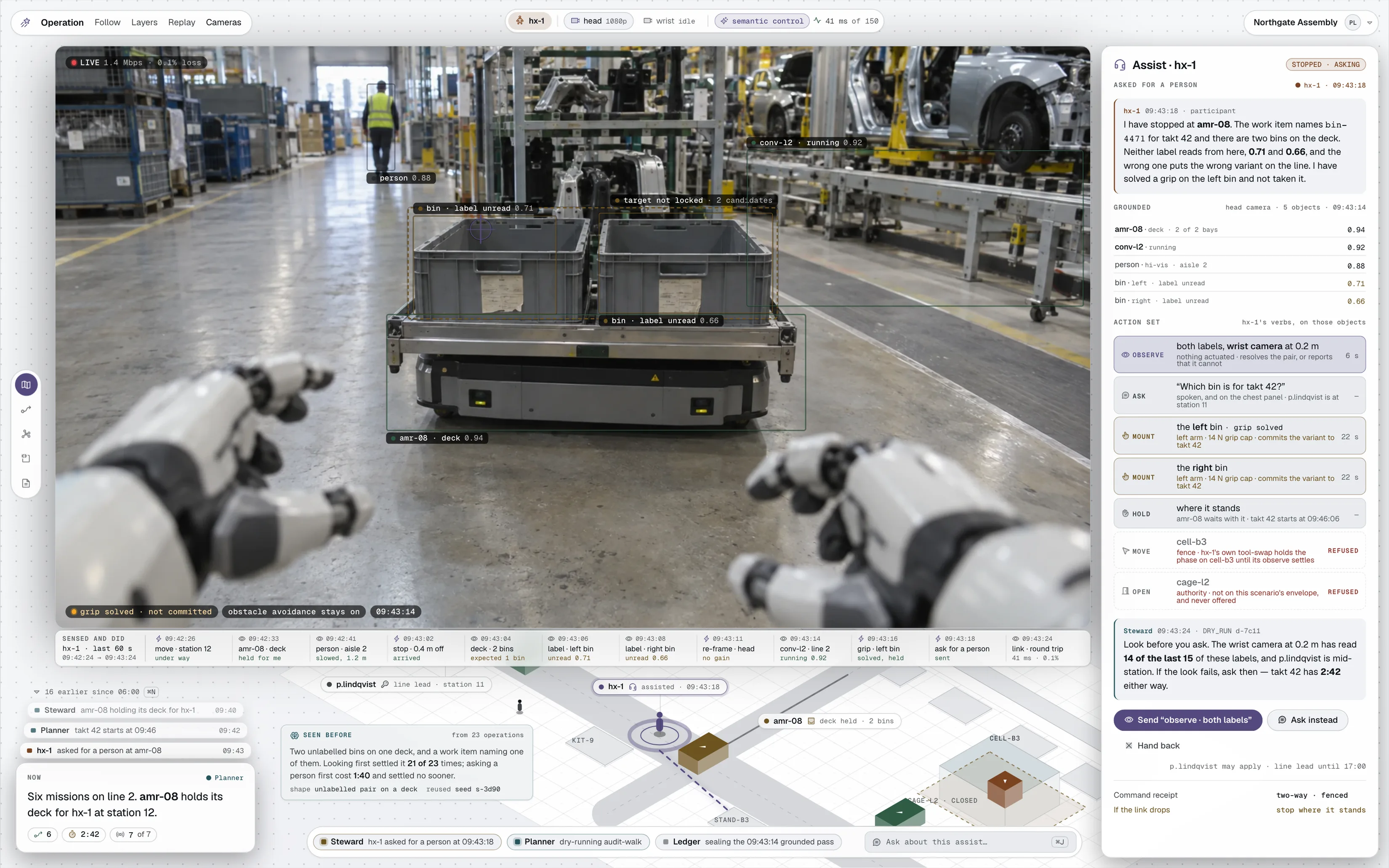
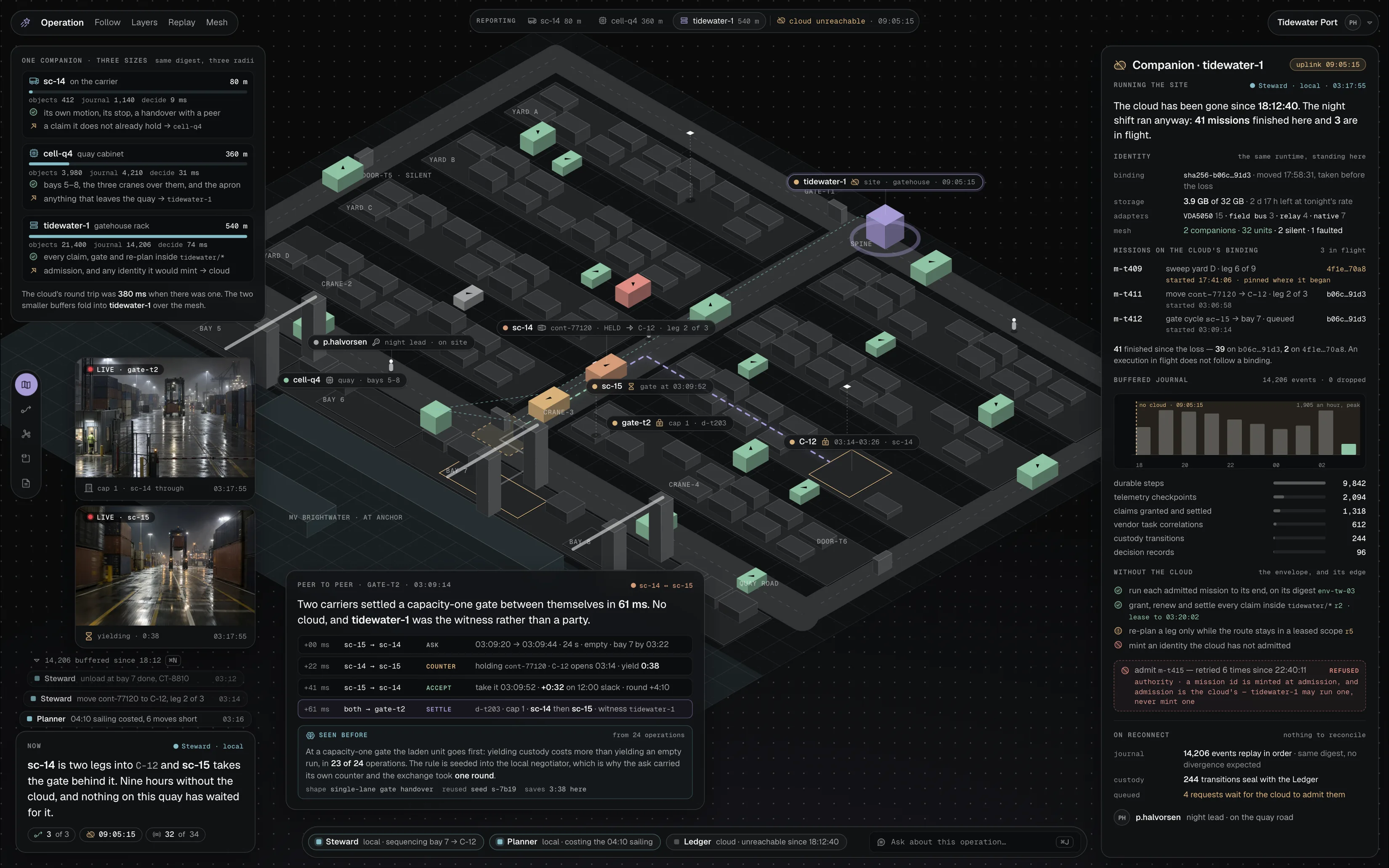
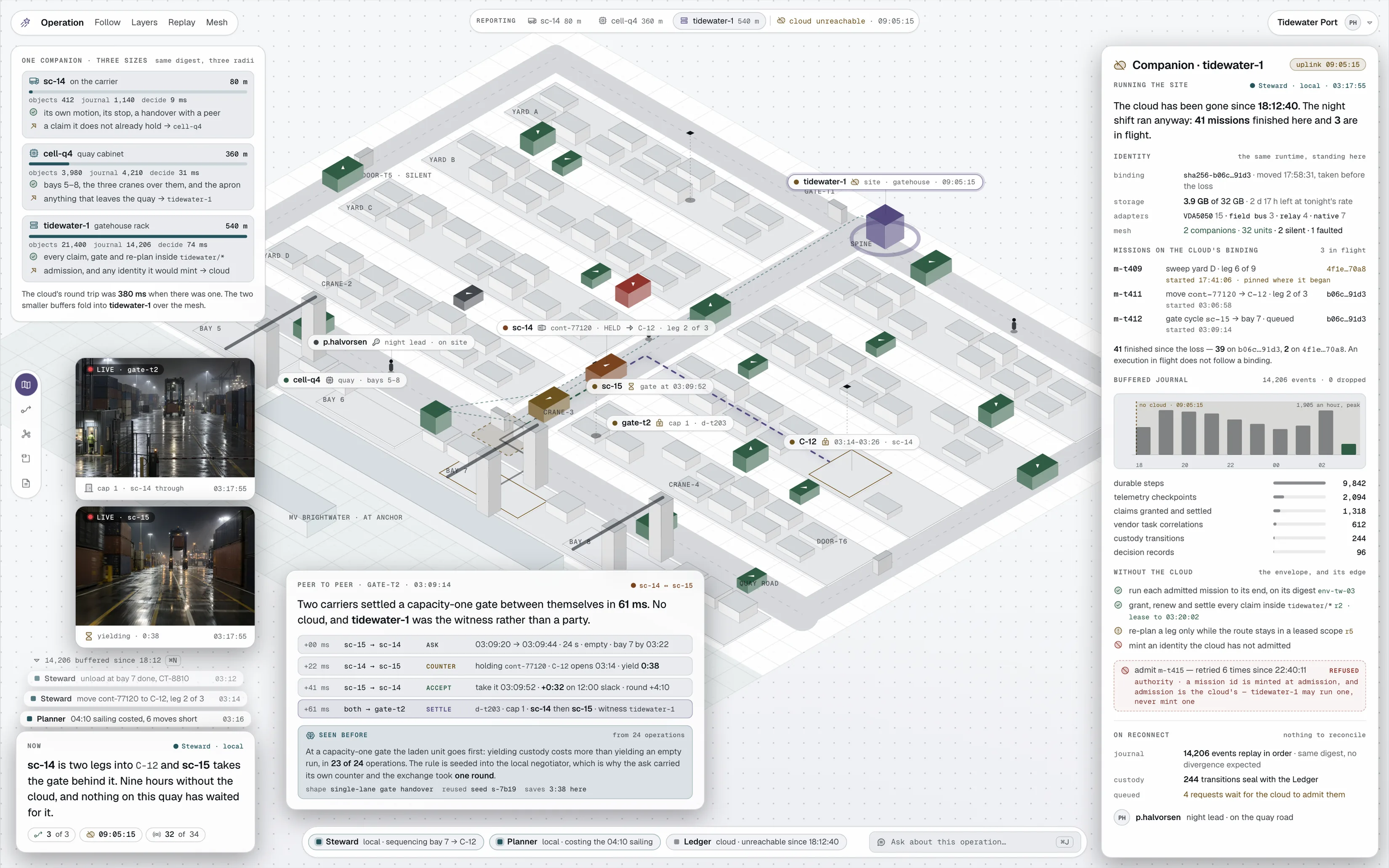
One mind, two places it thinks, one authority boundary.
The cloud oversees the whole operation and plans across it. The Companion watches one machine and acts for it now, and what it senses and does is recorded where the work is, in a ledger your operation keeps. Both run policy an agent wrote, pinned by the same digest, so they agree on the rules. They can still see different worlds, so the boundary is explicit: a Companion acts inside the authority delegated to it, anything globally exclusive waits out a partition rather than guessing, and every conflict that reconciliation finds is recorded and resolved in the open.